


Warts are skin diseases that are contagious in nature.The pathogen is the human papillomavirus.They are small, tumor-like, benign skin structures that look like a papilla or a nodule.They are usually not inflammatory in nature.
You can become infected with the papillomavirus through contact with a sick person, including through sexual contact, through household items, bed linen, towels, toys, dishes and through injuries to the skin.The incubation period is 2 weeks to 2-3 months.
If the warts are small and do not cause any discomfort, they can be left alone.If they are exposed to mechanical friction on clothing, cause pain when touched or cause physical and psychological discomfort, doctors advise getting rid of them.
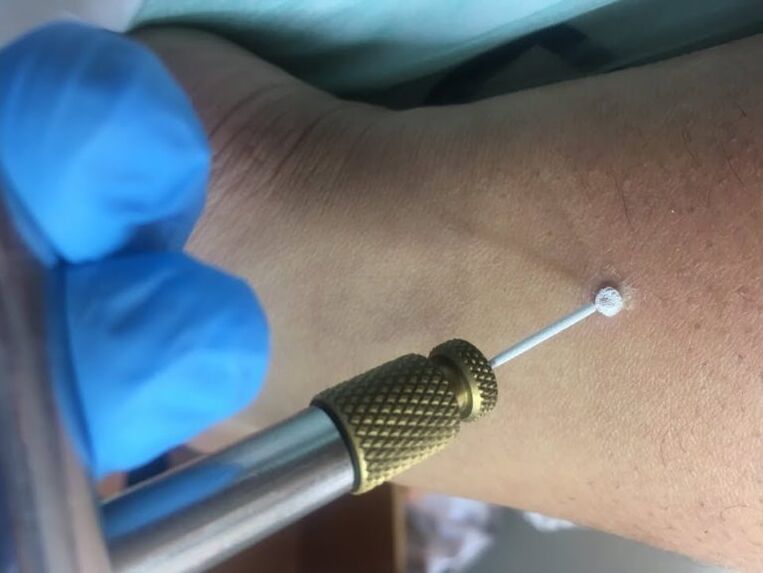
Wart removal methods
Modern medicine today offers several effective medical procedures for removing warts.These are the following methods:
- laser burning;
- cryodestruction;
- surgical removal;
- Electrocoagulation.
Let's take a closer look at each of the methods for removing skin lesions.
Laser
Laser is currently considered one of the most effective methods for removing skin tags.The method is painless, highly effective and has a minimum of consequences and complications in the form of scars, scars and skin hyperpigmentation.
The main effect of the device is the evaporation (erbium laser) or coagulation of skin cells (carbon dioxide laser).The principle of operation of the laser is the photomechanical destruction of the wart tissue and the sequential removal of its layers by a device.Light energy is converted into heat energy, which contributes to the destruction of skin formations.
Instructions for use
Any type of wart can be removed with a laser:
- plantar;
- common growths on the body;
- Apartment.
Laser burning of warts is done layer by layer under local anesthesia.The process takes several minutes.The penetration depth and exposure time of the laser depend on the depth and location of the structure.A small depression remains at the place of growth;after a few weeks it evens out.
After removing growths with a laser beam, no special skin care is required.The resulting dimple will correct itself after 2-5 weeks.If the growths were on the feet, the feet should be protected from excessive stress for 2 weeks.
Contraindications
Despite its advantages, laser treatment still has some contraindications.It cannot be used in the following cases:
- high temperature;
- colds (ARVI, acute respiratory infections, flu, sore throat);
- Hypertension;
- the presence of a herpes infection in the acute stage.
Pregnant and nursing mothers should only use the laser with extreme caution and only after consulting a doctor.
Cryodestruction
This method uses liquid nitrogen.The skin tag is exposed to low nitrogen temperatures.Freezing causes tissue to die.That is, the cells of the modified skin are significantly cooled under the influence of nitrogen, as a result of which the water in them freezes.When water freezes, it expands, causing the cell to rupture and die.Education simply stops “living”, collapses and dies.
Application instructions:
- the wart changes shape or color;
- the formation is constantly injured, hurts, itches, itches, bleeds;
- growth of formations throughout the body;
- has the appearance of a cosmetic defect;
- located on the labia;
- at the patient's request.
The procedure is carried out in different ways - hardware (cryoprobe) or manual (special applicator, 25-30 cm long).The manual method is more commonly used than the hardware method.
Anesthesia is carried out with novocaine or lidocaine.A cotton applicator is dipped into a container of nitrogen and applied to the affected area with light pressure.Processing time is 10-30 seconds depending on the size of the wart.After the first manipulation, a break of 1-2 minutes is taken to see how the nitrogen affects the tissue.When frozen with nitrogen, the growth begins to pale, then turns white and becomes more dense in structure.The procedure can be repeated 3-5 times with an interval of 3-5 days.
The next day a bubble appears in this place.This is a normal phenomenon and should not be alarmed.It can be reddish or whitish.If the blister is small and doesn't bother you, you don't need to open it.It opens by itself after 5-6 days.New, young skin forms underneath.If the blister is large and begins to hurt from the pressure of the fluid inside, it can be carefully opened.It is better to have this done by a doctor to avoid infection.If you don't want to go to the doctor, you need to open it with a sterile needle heated over a fire.After the puncture, the wound is treated with an antiseptic.A gauze bandage is placed over it and wrapped with a bandage.You can take painkillers for pain.
A week after the procedure, the surface of the skin darkens, begins to peel and the growths disappear.During treatment and peeling, the skin should be wiped with a 2% salicylic alcohol solution.
Contraindications
This method has no contraindications.Nitrogen can be used by children and pregnant women.Complications can arise if the procedure is performed incorrectly or the rules for caring for wounds after manipulations are violated.
Surgical excision
Surgical removal of warts is performed when the growths are large, too deep, shallow, and occupy large areas on the body.The operation is performed under local anesthesia using a surgical scalpel.The skin structure is excised and intradermal cosmetic sutures are applied.They will be removed after a week.After such an operation, a small, light, thin and flat scar 2-3 mm long remains.An absorbable silicone plaster is placed on it for quick healing.
After the operation, visiting solariums and baths as well as tearing off the resulting crust is prohibited.Do not moisten the wound in the first week, only treat it with antiseptics and observe hygiene.
Contraindications:
- pregnancy and breastfeeding period;
- exacerbation of herpes;
- inflammatory, infectious processes in the body.
Electrocoagulation
The method involves the use of an electrocoagulator.Electric shocks can be used to remove any type of wart, except plantar warts, which have a thicker structure.
The procedure is carried out under local anesthesia.A high frequency current is supplied to the metal loop.It cuts off the growth and coagulates the surrounding tissue.The surrounding tissue is heated, preventing bleeding and further spread of the virus to healthy areas.
After exposure to electricity, a crust forms;it disappears on its own after 7-10 days.The wound must be treated with an antiseptic and must not be wetted with water.A slight, shallow scar may remain.
Contraindications:
- low blood clotting;
- intolerance to electrical procedures;
- exacerbation of herpes;
- oncological diseases;
- Exacerbation of chronic diseases.
Many people are interested in the question: what is better to remove warts, laser or nitrogen?Compared to other methods of removing growths, laser has many advantages, including the following:
- speed of the procedure (2-3 minutes);
- absence of scars and scars;
- Painlessness;
- exclusion of infection during manipulations;
- no risk of damage to healthy areas;
- the likelihood of relapse is minimized;
- There are almost no contraindications.
Nitrogen can be used by children and pregnant women, has no contraindications, is affordable and the procedure is performed quickly.However, if the technique is violated, scars may remain.The wound must be cared for carefully.Relapses can occur.
The removal of warts with nitrogen is now also considered an effective treatment method, but the laser is more precise, painless and leaves no traces, which is very important.
It is advisable to combine the described wart removal methods with general anti-relapse treatment.
The likelihood of warts developing again depends on the quality and timeliness of the procedures as well as the state of the immune system.To find out which removal methods are right for you, you should consult a doctor for advice.